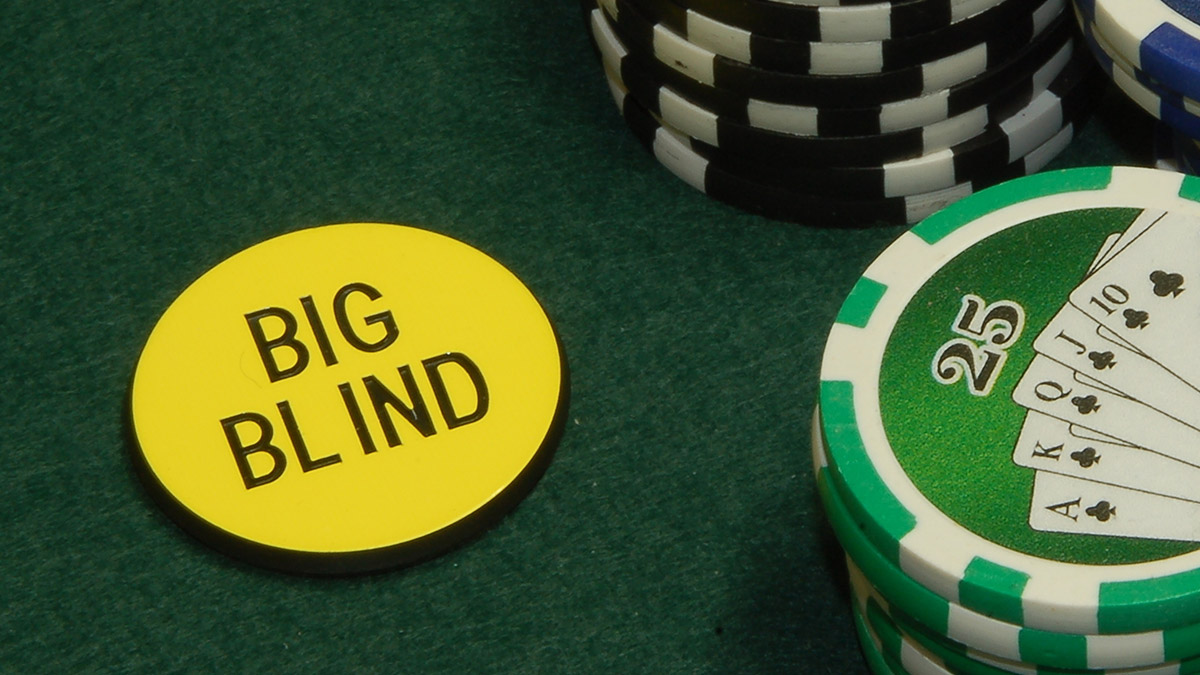
Texas Holdem Poker Big Blind Small Blind
- Texas Holdem Rules Blinds
- Texas Holdem Poker Big Blind Small Blind Plans
- Texas Holdem Blinds Chart
- Texas Holdem Poker Big Blind Small Blind Visually
- Texas Holdem Poker Big Blind Small Blind Button
Position is one of the most important concepts in poker and is something that a lot of new players get completely wrong.
The player immediately clockwise from the small blind posts the “big blind”, which is usually twice the size of the small blind. Blinds can vary so make sure you check before you join a table. In some games, particularly tournaments, each player may also be required to post an ‘ante’ at the beginning of each hand into the pot. In your most popular poker variants (Hold'em, Omaha), the small blind is responsible to putting the 'small blind' into the pot before the hand starts, while the big blind must put the 'big blind' into the middle. For instance - let's say that you are playing in a $1/$2 cash game. If you only have to call 1/3 of a small bet, you would almost always call unless you expected the big blind to raise. If you have to call 2/3 of the small bet, you should fold much more often and be much more selective about the hands you call with. For this discussion, we will assume that the small blind is 1/2 the size of the big blind. In Texas Hold'em poker, the order of seats is small blind, big blind, under the gun, cutoff, and button, with the dealer, positioned to take action after the button position. If there are more than five players, the others are positioned between the under the gun position and the cutoff position.
To put it simply:
Position in poker refers to the order which players are allowed to act. A player who acts first is “out of position” while a player who acts last is “in position”. Playing in position gives a distinct advantage due to the extra information gained and the ability to more effectively control the size of the pot.
There are two scenarios to discuss regarding position: preflop and postflop.
During the preflop round of betting, you can either be playing from early, middle, late position or the blinds with further breakdowns depending on your exact seat (which we will get into in a moment).
While postflop, your actual seat doesn’t matter and it becomes much simpler because you are either “in position” if you act last, “out of position” if you act first or somewhere in between if there are more than two players in the pot.
The important thing to remember is that these two aspects are related. When you play from an early position preflop, you are more likely to have to play out of position postflop. Whereas if you play a hand from late position you are fairly likely (or in some cases guaranteed) to be playing in position for the rest of the hand.
The fact that your starting seat determines whether you are more or less likely to be playing in position postflop is a very important factor that drives our opening strategy quite significantly.
Let’s dig deeper into this and find out what the positions are on the table and why understanding position is so important to playing winning poker.
Table Of Contents
- What are the starting positions in poker?
What are the starting positions in poker?
Each seat at the table is given a unique name which allows poker players to easily identify what hands they should be playing (more on that later) and how they might expect their opponents to play.

These seats are grouped into one of four categories:
- Early position
- Middle position
- Late position
- The blinds
The naming of the positions differs slightly depending on how many players are seated at your table, but let’s first take full-ring (9 handed) which is the most common casino format.
The image below shows the four categories we mentioned but also broken down further with the names of each seat.
In case you aren’t familiar with the acronyms, here’s what they stand for:
- UTG: Under the gun
- MP: Middle position
- HJ: Hijack
- CO: Cutoff
- BTN: Button
- SB: Small blind
- BB: Big blind
Early position
The first seat to act is referred to as under the gun and is located in early position. “Under the gun” is a term that means to be “under pressure to act” as in you are “being held at gunpoint”.

This translates to the analogy of the first seat at the poker table who is under pressure to make the opening decision of the freshly dealt hand.
On a full ring table with nine players in total, there are eight players waiting to act after UTG. So there is a strong likelihood that if you decide to play your hand, another player at the table will wake up with a premium hand.
Even if someone is dealt a mediocre hand and decides to play, you will be playing out of position on postflop unless they happen to be in the blinds.
Because of this, you must carefully select what hands you wish to play.
To illustrate this a little further, let’s imagine we would like to open 66 from UTG. To some, this may be a fairly standard open.
But consider the probability of that any one of these players has a strong or premium hand of 77+, AJs+, KQs, AQo+, KQo
This range represents 7.5% off all hands, and the probability of a player having one of these hands is shown below:
| Number of players on the table | 1 | 2 | 3 | 4 | 5 | 6 | 7 | 8 |
|---|---|---|---|---|---|---|---|---|
| Odds of a player having 77+, AJs+, KQs, AQo+, KQo | 8% | 14% | 21% | 27% | 32% | 37% | 42% | 46% |
So there is almost 50% chance some has a hand that is at least flipping with 66 and in many cases dominating. Pocket 66s only has 37% chance of winning if you were to go all-in versus that range, however, you will realise a lot less of that equity due to the likelihood of high card to your pair making it very difficult to play.
Equity realisation is a complicated subject which I won’t go into detail here on but PokerNerve has a great article on the topic which you can read here.
So the key takeaway:
Moving clockwise around the table, the next player to act is referred to as “under the gun plus one” or UTG+1. This seat plays very similarly to the UTG and hence these two positions are grouped into early position poker strategy.
Since there are only seven players left to act when opening from UTG+1, you can play slightly more hands. A typical opening range on a full ring table will be approximately 9% from UTG and 10% from UTG +1 which looks something like this:
These images are from a piece of software called Equilab which you can download for free here. This software allows you to save your ranges for later, turn percentage opens into actual hand ranges and calculate your equity versus another hand or range.
Middle position
The next position category is middle position. From here you should still be playing fairly conservatively, however, you can open a few more combos of hands when compared to UTG since two players have already folded meaning it is less likely:
- That you will come up against a strong hand
- That you will be forced to play out of position postflop
MP+1 should also be played in a similar manner to MP, albeit with slightly looser starting hand requirements.
A typical opening range will be approximately 12% from MP and 16% for MP +1 as shown below:
Late position
Following MP is late position which represents the three seats of hijack, cutoff and button.
We use individual names for each of these positions since they play quite differently and as a result, there is quite a large difference in strategy needed.
Although this might seem like a lot to take in at the moment, with all the different seat names and acronyms, you will have no problem remembering once you get in some practice. It completely automatic to me now and I don’t even have to think about it.
Hijack will play more hands than MP with a 19% opening range but it’s not until the cutoff and the button where we really start to open our range up. For example, in the cutoff we will like to open 26% or so of hands whereas on the button (OTB), we will open closer to 45% of hands if you are facing suitable players in the blinds.
Here is what the button opening rang might look like:
The reason for the stark adjustment in starting hands is because there are so few players left to act (either 3 for the cutoff, or 2 for the button) and if we do get action, we will be in position against the blinds.
Due to the fact that you will always act last on the button when playing postflop, it is considered the best and is almost always the most profitable seat on a poker table.
The blinds
The blinds are a slightly different kettle of fish. Firstly, players in the blind have to put in a small “fee” before seeing their cards i.e. there are putting in money blind into the pot, hence the name.
Secondly, when playing from the blinds, you will mostly be reacting to other player’s raises as opposed to make them yourself. This forces you to use a different strategy than we have been using up until now – you must now start calling much more often, particularly from the big blind.
The Small Blind is the worst seat (as you will always act out of position and act with the least amount of information) and the Big Blind is the least profitable seat on the table as you have to put a whole big blind into the pot without even seeing your cards.
The two redeeming qualities of the big blind are that we already have 1 bb invested into the pot which means despite our positional disadvantage versus all seats except the SB, we will usually have the opportunity to “close the action” by calling and seeing the flop.
Closing the action means that we are guaranteed to realise some of our equity (potentially allowing us to hit a piece of the flop). The same can’t be said for the SB where if we call a raise, the Big Blind has the opportunity to reraise us with a squeeze and put us in a tough spot.
6-max tables generally play much more aggressively and in many ways can be thought of by just simply removing the first three seats from a full ring table.
However, the naming convention also changes somewhat i.e. the first player to act in a 6max table is still called under the gun (and not MP+1 as would be the case in a full ring table).
The naming convention for a 6max table is shown below.
For the difference between a fullring and 6max table strategy, see my article here on this topic.
Note that in a 10 handed table there is also an UTG+2 added before MP starts. In this case, UTG should play slightly tighter and on a 9-handed table.
Poker Position Hand Chart:
Here is an example of how we would play pairs in a 6max game:
As shown, we should almost always play pairs since they are one of the best starting hand types. But with the other hand types, it is less cut and dry.
To receive your full free 6max & full ring starting hand chart, Click here for 6max and here for fullring.
Check out the Common Poker Mistakesto keep learning.
Or return to poker 101?
Online Poker » Poker Strategy » Texas Hold Em » How to Play Texas Hold Em
Known as the 'Cadillac of Poker,' Texas Hold'em is what many people refer to as the poker game that takes minutes to learn and a lifetime to master. In fact, it is so easy to learn that millions have picked up the game since the 'Moneymaker boom' with many players going on to become pro and compete in some of the biggest events in Nevada.
Now, we cannot guarantee that you will make lots of money playing poker after reading this article. However, we can guarantee that you will have a solid understanding of how to play Texas Hold'em so that the next time you sit down at a table, you will look and feel like a poker pro.
Texas Hold'em Rules
Texas Holdem Rules Blinds
* Before the cards are dealt, forced bets are made by the first two players to the left of the dealer button. These players are known as the 'blinds.' The player to the direct left of the button is the 'small blind' and the small blind puts out a forced bet at the beginning of each hand that is equivalent to half the big blind. The 'big blind' is the player that is to the immediate left of the small blind and at the beginning of each hand the big blind must post the larger of the two blinds.
For example, in a $1/$2 Texas Hold'em game, the small blind would have to post $1 at the start of each game and the big blind would be required to post $2.
* After the blinds have been posted, the dealer now then deals the cards one at a time to each player starting with the small blind and dealing clockwise until each player has two cards faced down.
* Now, the first betting round begins with the player to the immediate left of the big blind who is also commonly referred to as the player 'under the gun' or UTG for short. Each player can fold, call or raise with the amounts depending on the variation of Texas Hold'em that is being played. Any time a raise is made, this is the new minimum bet to call or minimum to use when re-raising if applicable.
If playing No Limit Hold'em, a player must meet the minimum bet if calling or if raising, the minimum bet also must be used. But at any time, a player can declare 'All-In' and move their whole stack into the pot.
Fixed Limit Hold'em allows players to bet a certain amount on each street. For example, in a $1/$2 fixed limit game, players can bet up to $1 when dealt their cards and on the flop and $2 on 4th and 5th street. Raising is generally capped at a maximum of 3 per betting round.
When playing Pot Limit Hold'em, players can raise up to the size of the pot up to a maximum of 3 times per betting round.
The betting round continues like this until it reaches the small blind, who will only need to match the second half of his or her bet (unless it has been raised in front) to continue with the hand. If the bet has not been raised in front, the big blind can 'check his option' which means that he or she does not care to raise but has already invested the minimum bet and would like to see the flop.
* After the first betting round, the dealer now deals the 'flop' which is the first 3 of the 5 total community cards that players can use to make their 5 card poker hand.
* Now, the second betting round will begin, this time starting with the small blind or the closest active player to the left of the dealer button.
Players will have similar options as they did in the first betting round, except now players can 'check' their hand instead of folding, calling or raising. Checking just simply means that you would like to pass on making a bet of any kind. It is possible for all players to check and completely skip a betting round.
However, if a player wishes to make a bet, the minimum bet must be equivalent or higher than the big blind. Then each player who wishes to stay in the hand must at least call the raise but if players wish to raise themselves, the previous raise is the new minimum.
Once betting has reached the dealer button or the last active player closest to the right of the dealer button, then the betting round has been completed.
* After the second betting round, the dealer will now deal the 4th community card which is also known as 'the turn' or '4th street.'
* The 3rd betting round will begin after the turn with betting round starting once again with the small blind or the closest active player to the left of the dealer button. This betting round is the same as the second betting round with players having the option to check, raise, call or fold their hands.
* The last community card known as '5th street' or 'the river' is now dealt after the 3rd betting round. Players can use any 5 out of 7 available cards (2 in their hand, 5 on the board) to make the best 5 card poker hand possible.
* After the river, the 4th and final betting round will now begin. This betting round is the same as the second and third betting round with players having the option to check, raise, call or fold their hands.
Once this betting round has been completed, the remaining players will now flip their cards over and the player with the best hand will take down the pot.
Texas Holdem Poker Big Blind Small Blind Plans
* The dealer button now moves one seat to the left and the action now begins from the top.
Important Notes
Texas Holdem Blinds Chart
* It is possible to not have to go to showdown. If at anytime a player forces all other opponents to fold, they will win the pot at that time without having to show their cards. This is possible on any betting round whether it is pre-flop, post-flop, on 4th or 5th street.
Texas Holdem Poker Big Blind Small Blind Visually
Playing Texas Hold'em
Texas Holdem Poker Big Blind Small Blind Button
As you can see, learning how to play Texas Hold'em only takes a few minutes to learn. But once you do, you will realize that was just the beginning and will quickly understand why it has been said that it takes a lifetime to master, as there are countless poker strategies and tips to learn.